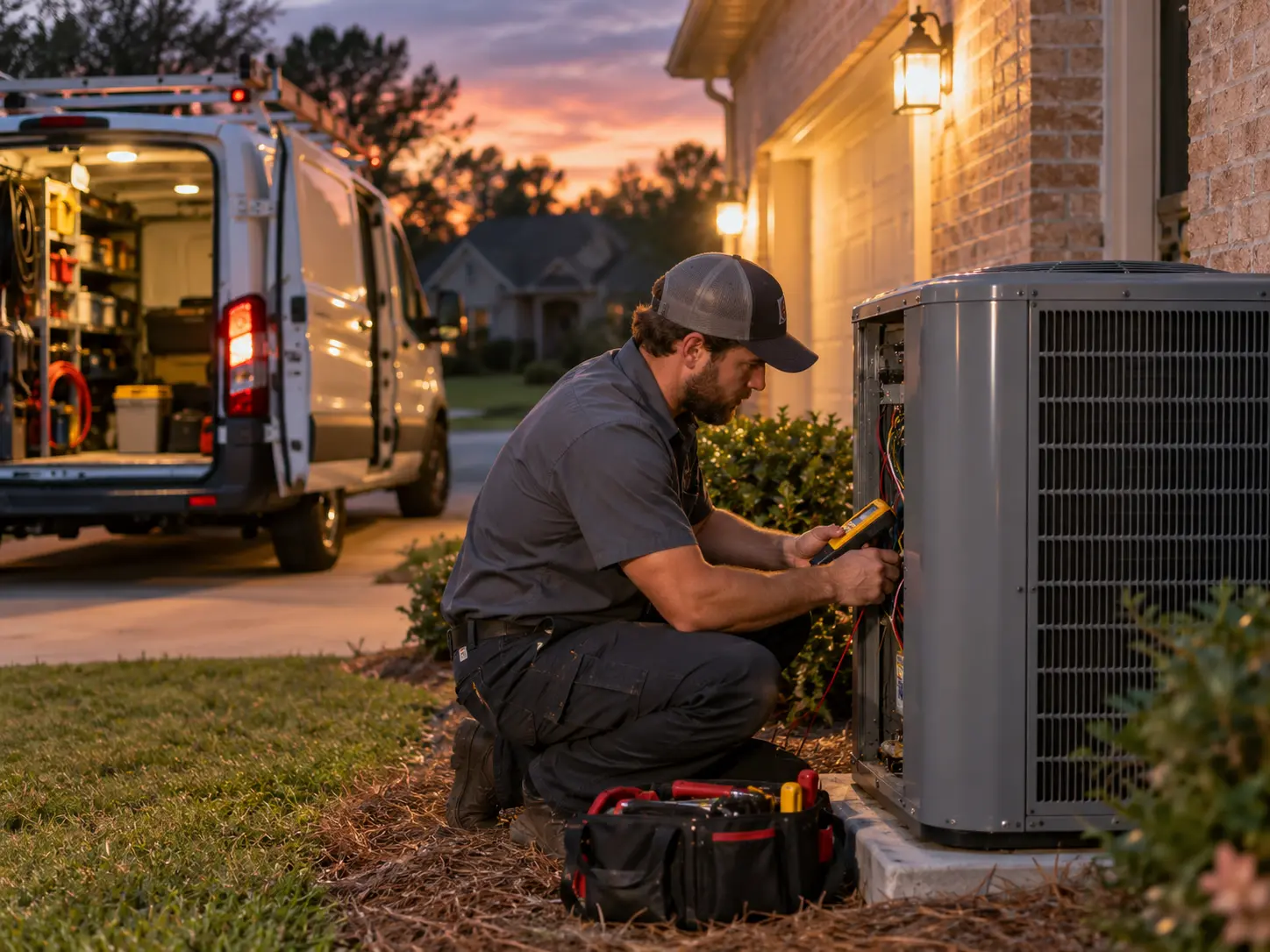
Emergency AC Repair in Montgomery, AL
Some cooling failures can wait until morning. Others should be looked at now — especially anything involving electrical smells, repeated breaker trips or a house that keeps climbing in temperature. Emergency service may be available nights, weekends and holidays, subject to local provider availability.
24/7 and same-day availability depends on participating providers, location and current technician capacity.
An AC emergency is usually defined by two things: the risk of further damage to the equipment, and the risk to the people in the house. A complete loss of cooling during a hot stretch matters more when there are infants, older adults or anyone with a medical condition affected by heat in the home.
Electrical symptoms move a call to the front of the line. A breaker that trips repeatedly, a burning or hot-plastic odor, or a scorched smell near the air handler means the system should be shut off at the thermostat and the breaker left off until a technician has inspected it.
Water is the other common after-hours emergency. A blocked condensate drain can overflow into a closet, attic or ceiling. Shutting the system off stops the coil from producing more condensate while you wait.
Symptoms homeowners notice
- Complete loss of cooling in the middle of a hot afternoon or overnight
- The system will not start at all from the thermostat
- Burning, hot electrical or scorched-plastic smell near the indoor unit
- The breaker trips again immediately after being reset once
- Heavy ice on the refrigerant lines or the indoor coil
- Water running from the air handler, ceiling stains or a full drain pan
- System starts and shuts down repeatedly within minutes
- The outdoor condenser is silent while the indoor blower runs
What you can safely check
- Turn the system to Off at the thermostat if you smell burning or see water or heavy ice
- Check both the indoor and outdoor breakers, and reset only once
- Replace an obviously dirty filter before restarting
- Move furniture, rugs or storage away from return grilles
- Place a towel or shallow pan under an actively dripping air handler
Never open electrical compartments, handle refrigerant or bypass a safety control. Those steps belong to a qualified HVAC professional.
Likely causes
Electrical failure under load
Contactors, capacitors and compressor windings fail most often during long high-demand runtimes. That is why so many total-loss-of-cooling calls happen late on hot afternoons rather than in mild weather.
Condensate overflow and safety shutdown
Many systems include a float switch that cuts cooling when the drain pan fills. That is the system protecting your ceiling — the fix is clearing the blockage, not bypassing the switch.
Severe icing
Airflow restriction or low refrigerant charge can freeze the coil solid. A frozen system moves almost no air, and running the compressor in that state risks liquid refrigerant returning to it.
Outdoor unit lockout
High-pressure or low-pressure safety switches, a failed fan motor, or a tripped disconnect can leave the condenser off while the thermostat keeps calling for cooling.
What to do while you wait
If the system is off and the house is warm, small steps help: close blinds on sun-facing windows, run ceiling fans in occupied rooms, avoid using the oven or dryer, and keep interior doors open so air can move.
Do not open the electrical compartment of the air handler or condenser, and do not attempt to add refrigerant. Both carry real injury risk and can make the diagnosis harder for the technician who arrives.
- Leave the breaker off if you smelled anything burning
- Keep pets and children away from a leaking indoor unit
- Write down what you observed, including times — it speeds up diagnosis
When professional service is needed
- Any burning or electrical odor, at any hour
- A breaker that will not stay reset
- Water actively entering ceilings, walls or flooring
- No cooling at all with vulnerable household members at home
- A compressor that hums loudly and then shuts off
What a provider may inspect
- Line voltage, disconnect and breaker condition
- Contactor, capacitor and relay condition under load
- Compressor windings and locked-rotor symptoms
- Safety switch status, including high-pressure and float switches
- Coil condition and the cause of any icing
- Drain line blockage and pan integrity
Montgomery-area context
During long central Alabama cooling seasons, after-hours demand rises sharply on the hottest days — which is exactly when residential systems are most likely to fail. Calling early in the evening rather than waiting until midnight often gives more scheduling options.
Humid conditions make condensate emergencies more common than homeowners expect. A drain that dripped harmlessly in April can overflow in July when the coil is removing far more moisture per hour.
Emergency availability depends on which providers are participating in your area at that moment, how far the address is from an available technician, and how many calls are already in the queue. Calling is the fastest way to find out what is actually available tonight.
What About Repair Cost?
Pricing is set by each independent provider and varies with the diagnosis, the system involved, the specific component, how accessible the equipment is, parts availability and labor. Ask the provider you speak with to explain their diagnostic process and how they quote work before it begins.
Common questions
Is emergency AC repair really available 24/7?
Emergency residential AC service may be available 24 hours a day, including nights, weekends and holidays. Actual availability depends on which independent providers are participating in your area, your location, current technician capacity and demand, so it is not guaranteed. Calling is the fastest way to check what is available right now.
What counts as an AC emergency versus something that can wait?
Electrical odors, repeated breaker trips, active water leaks into the structure, and complete loss of cooling with heat-vulnerable people in the home are treated as urgent. Uneven cooling, slightly longer runtimes, a noisy but functioning fan, or a thermostat that is a few degrees off can usually be scheduled during normal hours.
Should I turn the AC off before help arrives?
Yes, in most emergency scenarios. If you see ice, water, or you smell something burning, shut the system off at the thermostat. Continuing to run it can turn a repairable problem into compressor replacement or water damage. If the only symptom is weak cooling and there is no ice or odor, it is usually fine to leave it off and wait.
Do after-hours calls cost more?
Each independent provider sets its own pricing, and many trades charge differently outside normal business hours. This site does not set or guarantee pricing. Ask the provider directly how they handle after-hours diagnostic charges and how they quote repairs before work begins.
Service Request
Request Residential AC Service
Tell us what your air conditioner is doing and your request can be shared with local residential service providers serving the Montgomery area.
Urgent AC problem?
Calling is usually the fastest way to check current residential availability, including nights and weekends.
334-835-344524/7 and same-day availability depends on participating providers, location and current technician capacity.
Don't Sit in a Hot House
If your home AC isn't cooling properly, call to check current residential service availability in Montgomery and nearby communities.
24/7 and same-day availability depends on participating providers, location and current technician capacity.