Signs Your AC Needs Repair
Most residential cooling failures announce themselves first: airflow weakens, runtimes lengthen, a new noise appears, humidity creeps up, or bills rise without a change in habits. Acting on those signals is far cheaper than waiting for the system to stop entirely on the hottest afternoon of the year.
24/7 and same-day availability depends on participating providers, location and current technician capacity.
Quick answer
Most residential cooling failures announce themselves first: airflow weakens, runtimes lengthen, a new noise appears, humidity creeps up, or bills rise without a change in habits. Acting on those signals is far cheaper than waiting for the system to stop entirely on the hottest afternoon of the year.
Performance signs
These are the earliest and easiest to miss, because they develop gradually. A system that used to hold 74 comfortably and now settles at 77 by late afternoon has lost capacity, even though it is still technically working.
- Longer runtimes with no change in weather or settings
- Rooms that no longer reach the thermostat setting
- Air from the vents that feels cool but weak
- Indoor humidity that feels higher than it used to
- Electric bills rising without a change in habits
Sounds worth investigating
New noises are specific clues. Screeching or squealing often means a motor bearing or belt issue. Grinding suggests a failing motor. Repeated clicking at start can indicate a relay or contactor problem. A hum from the outdoor unit with the fan still is a classic capacitor symptom.
Loud banging or clanking should stop the system: something may be loose inside the blower or fan assembly, and running it risks additional damage.
- Screeching or squealing from the indoor or outdoor unit
- Grinding or metal-on-metal contact
- Humming outdoors with the fan not turning
- Repeated clicking or chattering at startup
- Loud banging — shut the system off
Smells that matter
A musty odor usually points to moisture in the system: a dirty evaporator coil, a restricted drain, or standing water in the pan. It is a maintenance issue and worth addressing, both for the equipment and for indoor air quality.
A burning, hot-plastic or electrical odor is different. Turn the system off, leave the breaker off, and have it inspected before running it again. That symptom is urgent regardless of the hour.
Visible signs
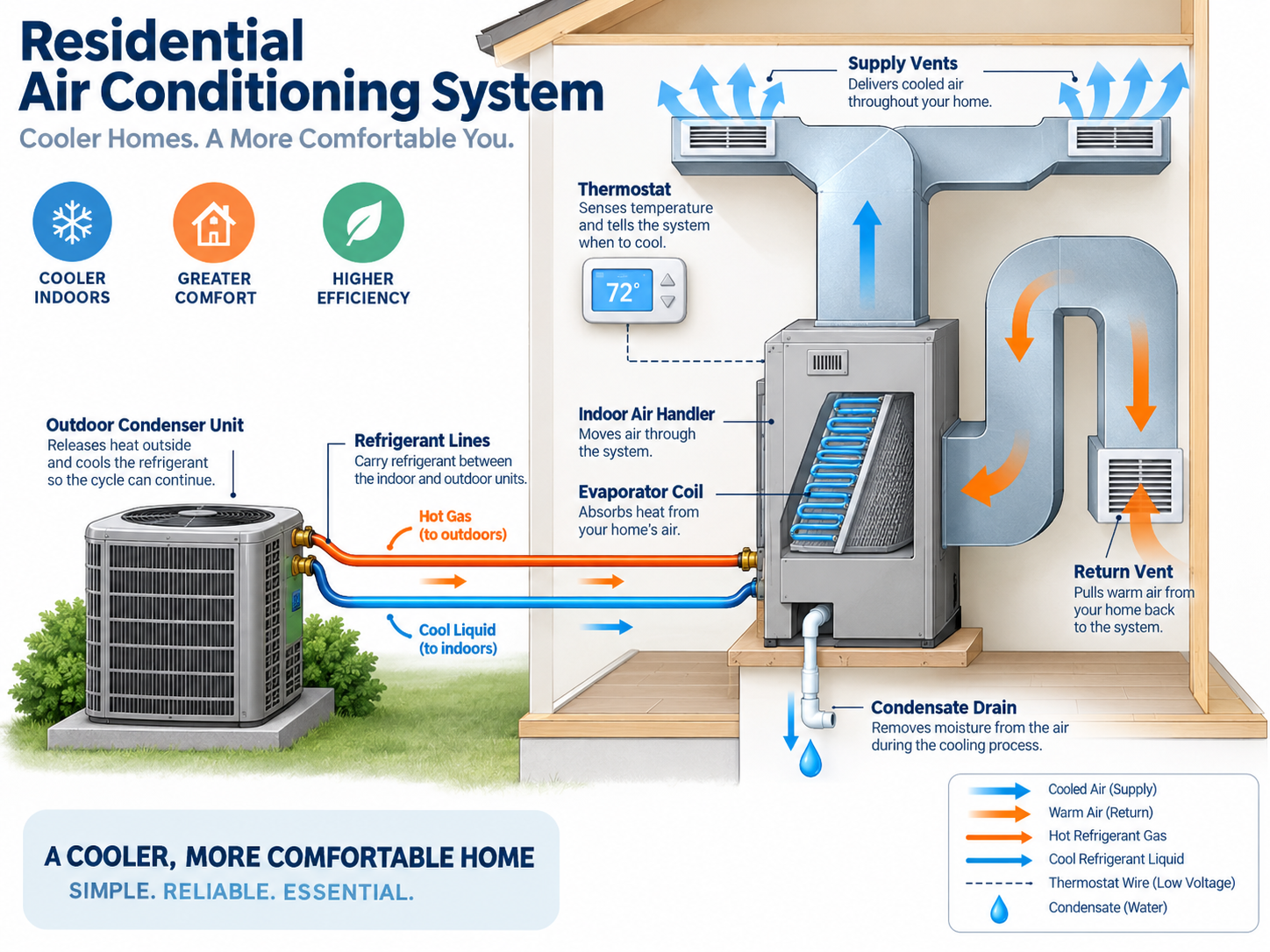
Ice on the coil or the larger copper line means the coil is running below freezing — airflow or charge. Water around the indoor unit or a stain on a ceiling below an attic air handler means the condensate system is not keeping up. Oily residue near refrigerant fittings can indicate a leak point.
Any of these warrant shutting cooling off rather than continuing to run the system while you decide.
- Ice on the evaporator coil or refrigerant lines
- Water in the drain pan or on the floor near the air handler
- Ceiling staining under an attic unit
- Oily film near refrigerant line fittings
- Scorched or discolored wiring or terminals
Behavioral signs
Short cycling — starting and stopping repeatedly — usually means a safety control is tripping or a component is struggling to start. Systems that shut themselves off mid-cycle with no other symptom often have a condensate float switch doing its job.
Breakers that trip on compressor start indicate a genuine electrical fault. Reset once at most; if it trips again, leave it off and have it tested.
What to treat as an emergency
Electrical odors, breakers that will not hold, water actively entering ceilings or flooring, and total loss of cooling with heat-sensitive household members in the home all justify immediate attention.
Emergency residential AC service may be available nights, weekends and holidays through participating independent providers, depending on service location, technician capacity and current demand. Availability is not guaranteed, so calling is the fastest way to find out what is actually possible.
Warning signs to take seriously
- Burning or electrical odor from the equipment
- Breaker tripping repeatedly on compressor start
- Water reaching ceilings, walls or flooring
- Loud banging or grinding from a running unit
- Complete loss of cooling in extreme heat with vulnerable occupants
Related questions
How do I know if I need repair or just maintenance?
If the system still cools reasonably and the symptoms are weak airflow, a dirty filter, mild efficiency loss or a musty smell, maintenance often resolves it. If cooling has clearly failed, a breaker trips, there is ice, water, a new mechanical noise or an odor, it is a repair situation and needs diagnosis.
My AC is noisy but still cooling. Can it wait?
A new noise means something has changed mechanically, and bearings, motors and loose components tend to worsen rather than stabilize. It is usually cheaper to address while the system is still running than after the part fails and takes something else with it. Loud banging or grinding should not wait at all — shut it off.
Are rising electric bills really an AC symptom?
They can be. Lost capacity from restricted airflow, a fouled coil or a low refrigerant charge means longer runtimes for the same comfort, and that shows up on the bill before it shows up as a breakdown. If bills rose noticeably without a change in weather, rates or habits, the system is worth checking.
The system shuts off by itself but there is nothing obviously wrong. Why?
A safety control is likely tripping. The most common is a condensate float switch responding to a restricted drain, followed by high-pressure trips from a dirty condenser and freeze-protection trips from airflow or charge problems. Each is testable, and each is protecting the equipment rather than malfunctioning.
Should I keep running the system until a technician arrives?
If the only symptom is reduced cooling, running it is generally fine. If there is ice, active water intrusion, a burning odor or a loud mechanical noise, shut it off. Continuing to run under those conditions is how a moderate repair becomes a compressor replacement or a water damage claim.
Service Request
Request Residential AC Service
Tell us what your air conditioner is doing and your request can be shared with local residential service providers serving the Montgomery area.
Urgent AC problem?
Calling is usually the fastest way to check current residential availability, including nights and weekends.
334-835-344524/7 and same-day availability depends on participating providers, location and current technician capacity.
Don't Sit in a Hot House
If your home AC isn't cooling properly, call to check current residential service availability in Montgomery and nearby communities.
24/7 and same-day availability depends on participating providers, location and current technician capacity.