Why Did My AC Electric Bill Suddenly Increase?
A cooling system costs money per hour it runs, so almost every bill increase comes down to more runtime, less capacity per hour, or both. Weather, a loaded filter, restricted airflow, dirty outdoor coils, leaking ducts, a failing component, a thermostat change, aging equipment, building air leakage and heat pump auxiliary heat in winter are the usual contributors — and several often stack up at once.
24/7 and same-day availability depends on participating providers, location and current technician capacity.
Quick answer
A cooling system costs money per hour it runs, so almost every bill increase comes down to more runtime, less capacity per hour, or both. Weather, a loaded filter, restricted airflow, dirty outdoor coils, leaking ducts, a failing component, a thermostat change, aging equipment, building air leakage and heat pump auxiliary heat in winter are the usual contributors — and several often stack up at once.
Start with runtime, not with the equipment
Electricity use is roughly hours of operation multiplied by how much power the system draws. If the bill went up, the useful question is what changed about how long the system runs.
Before assuming a fault, compare like with like: the same billing period last year, the number of days in the cycle, any rate changes on the bill itself, and whether the household changed — more people home, more laundry, a new appliance, guests, a different sleep schedule.
Longer cooling cycles
Longer, more frequent runtimes are the single most common reason a cooling bill rises. In a long, humid cooling season, systems here run for months rather than weeks, and a stretch of unusually demanding weather extends that further.
Longer runtime is not automatically a defect. It becomes a symptom when it is paired with rooms that do not reach setpoint, weak airflow, supply air that is not cool, rising indoor humidity, ice, or a sudden change in behavior.
Dirty filters and restricted airflow
A loaded filter reduces airflow, which reduces capacity per hour of operation. The system compensates by running longer to accomplish the same cooling, and the blower works harder against the restriction.
Restriction can also come from blocked return grilles, closed registers, crushed flexible duct, an undersized return, or a filter with a higher restriction rating than the system was designed for. Restriction is also the most common path to a frozen coil, which stops cooling entirely while the system keeps drawing power.
Dirty outdoor coils
The outdoor coil rejects the heat pulled out of your house. When it is coated with pollen, grass clippings, dryer lint or dust, the system cannot shed heat efficiently, operating pressures rise, the compressor works harder, and capacity drops.
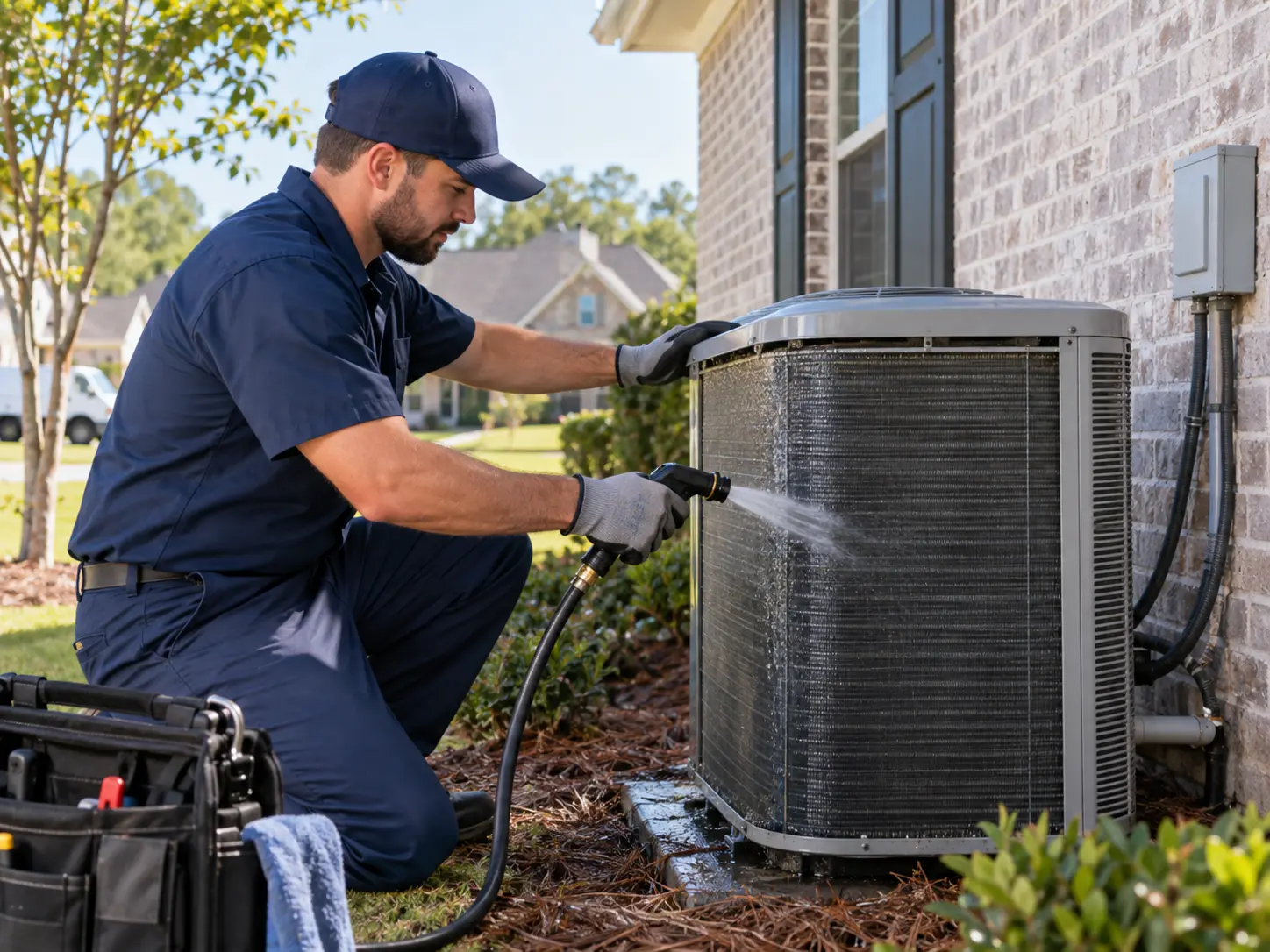
Shrubs, fencing, stacked items and mulch crowding the unit produce the same effect by restricting airflow across the coil. This is one of the few high-impact items a homeowner can address safely: keep clearance, and rinse gently with power off at the disconnect.
Duct leakage
Supply duct leaking into an attic delivers cooled air where nobody lives. Return duct leaking in that same attic pulls in hot, humid air the system then has to treat. Either way you pay to condition air that never benefits the house.
Duct leakage is invisible from inside the home and often explains a bill that is high without any obvious equipment fault. It is also frequently correctable, and worth asking about when a provider is on site.
Failing components
Equipment on its way to failure often uses more power before it stops working. A motor with worn bearings, a weak capacitor, a compressor operating at high pressures, a contactor with degraded contacts or a control problem causing short cycling all cost efficiency.
Refrigerant charge that is not correct also reduces capacity per hour, and because refrigerant is not consumed, a low charge points to a leak or to charge lost during earlier service rather than to normal use. That should be diagnosed rather than simply topped off.
- Weak capacitor or degraded contactor
- Condenser fan or blower motor problems
- Refrigerant charge that is not correct, indicating a leak
- Dirty evaporator or condenser coil
- Short cycling from controls, sizing or airflow restriction
- Compressor operating outside normal conditions
Thermostat changes and settings
A lower setpoint means more runtime. So does a lost schedule after a power outage, a battery change that reset a program, a new thermostat installed with different settings, or a household member quietly adjusting it.
Leaving the fan in ON also runs the blower continuously, which adds power use and can raise indoor humidity by re-evaporating moisture off the coil. AUTO is generally the right setting during cooling season.
Aging equipment
Older equipment is generally less efficient than current designs, and it also tends to have accumulated minor performance losses: coils that have been cleaned imperfectly for years, a blower wheel with buildup, motors past their prime, refrigerant charge that has drifted.
Age alone is not a reason to replace a working system, but it is context. If a bill has climbed gradually over several seasons on a system well past a decade of service, that is a different conversation from a bill that doubled in one month.
Insulation and air leakage
The building envelope determines how much heat the system has to remove. Thin or displaced attic insulation, unsealed attic hatches, gaps around recessed lights, leaky can lights and unsealed penetrations all add to the load, and they get worse as attic temperatures climb.
Envelope improvements reduce runtime without touching the equipment. They are also the reason two identical systems on the same street can produce very different bills.
Heat pump auxiliary heat in winter
If the home has a heat pump, a winter bill spike often comes from electric auxiliary heat rather than from the heat pump itself. Auxiliary heat uses substantially more electricity, and it engages during cold weather, during large temperature recoveries and during defrost cycles.
Deep overnight setbacks can trigger auxiliary heat during morning recovery, which is why aggressive setbacks sometimes cost more than they save on a heat pump. Frequent AUX or EM HEAT operation in mild weather is worth having checked.
Unusually demanding weather
Extended hot, humid stretches increase both the cooling load and the moisture-removal load, and systems respond by running longer. A bill that rises during a demanding period and returns to normal afterward is behaving as expected.
This site does not publish weather figures or projected savings numbers. What is useful is comparing your own bills against your own history and noting whether the increase came with any change in how the system behaves.
Safe homeowner checks
Work through these before assuming an equipment fault, and note anything that looks unusual.
- Replace the filter at every return location
- Confirm the thermostat setpoint, schedule and that the fan is on AUTO
- Check for a schedule that reset after a power outage
- Keep two feet of clearance around the outdoor unit and clear grass and leaves
- Rinse the outdoor coil gently with power off at the disconnect
- Open supply registers and clear obstructions from return grilles
- Look for ice on the coil or the larger refrigerant line
- Compare the bill against the same period last year and check for rate changes
- On a heat pump, note whether the thermostat shows auxiliary or emergency heat running
Bill increase, and what it may point toward
| What you notice | Possible areas to investigate | What to do next |
|---|---|---|
| Gradual climb over seasons | Coil condition, airflow, equipment age, duct leakage | Schedule maintenance and ask what was measured |
| Sudden jump with poor cooling | Refrigerant charge, failing component, airflow restriction | Arrange professional diagnosis |
| High bill but comfort is fine | Duct leakage, insulation, thermostat schedule, rates | Check settings, then ask about duct and envelope evaluation |
| Winter spike on a heat pump | Auxiliary heat operation, defrost, thermostat setback | Note AUX indication and arrange inspection |
| High bill plus long runtimes | Capacity loss, airflow, coil condition, weather demand | Change the filter and arrange measurement if it continues |
Warning signs to take seriously
- A large bill increase alongside cooling that has clearly declined
- A breaker that trips or equipment that hums, buzzes or struggles to start
- Ice on the coil or the larger refrigerant line
- Any burning or hot-plastic odor from the equipment
- A heat pump running auxiliary or emergency heat in mild weather
Related questions
How much can I expect to save by fixing these things?
No honest figure can be given without knowing your home, your ductwork, your equipment and your usage. Savings depend on what is actually wrong, how much runtime it was adding and local rates. Treat specific percentage promises with skepticism, and instead ask a provider what they measured, what they changed and why it should reduce runtime.
Is it cheaper to leave the AC at one temperature all day?
It depends on the house, the equipment and how deep the setback is. A modest setback while away generally reduces total runtime on a conventional cooling system, because less time spent cooling means less energy used. Very deep setbacks in extreme heat can leave the system running a long recovery, and on a heat pump in winter they can pull in expensive auxiliary heat.
Does closing vents in unused rooms save money?
Usually not, and it can cause problems. Closing registers raises static pressure, reduces total airflow, strains the blower and can contribute to a frozen coil. Duct systems are designed around a total airflow, and shutting off part of that does not reduce the equipment's power draw proportionally. Balancing is done with dampers, based on measurement.
Could a bill increase mean my system is failing?
It can be an early indicator. Motors with worn bearings, a weak capacitor, incorrect refrigerant charge and short cycling all reduce efficiency before they cause an outright breakdown. If higher usage comes with any change in cooling performance, airflow, noise or humidity, having the system measured is reasonable rather than waiting for a failure in peak heat.
Would a new thermostat lower my bill?
A programmable or smart thermostat can reduce unnecessary runtime through better scheduling, which is a real benefit. It cannot make a restricted, dirty or undercharged system efficient, and on a heat pump a thermostat configured incorrectly can increase auxiliary heat use. Fix the mechanical items first, then use scheduling to avoid runtime you do not need.
My bill is high but the house feels fine. What now?
That pattern points away from equipment failure and toward duct leakage, insulation and air sealing, thermostat schedule, or a rate or billing-period change. Check the bill itself for rate and day-count differences, confirm the schedule, then ask a provider about duct condition and airflow rather than assuming the equipment is at fault.
Related AC Problems
Service Request
Request Residential AC Service
Tell us what your air conditioner is doing and your request can be shared with local residential service providers serving the Montgomery area.
Urgent AC problem?
Calling is usually the fastest way to check current residential availability, including nights and weekends.
334-835-344524/7 and same-day availability depends on participating providers, location and current technician capacity.
Don't Sit in a Hot House
If your home AC isn't cooling properly, call to check current residential service availability in Montgomery and nearby communities.
24/7 and same-day availability depends on participating providers, location and current technician capacity.