
Why Is My AC Not Cooling?
An AC that runs without cooling is almost always failing at one of four things: moving enough air, moving heat outdoors, carrying the right refrigerant charge, or receiving the right commands from its controls. A dirty filter, a failed capacitor, low refrigerant charge and a thermostat left on the wrong setting cover the large majority of cases.
24/7 and same-day availability depends on participating providers, location and current technician capacity.
Quick answer
An AC that runs without cooling is almost always failing at one of four things: moving enough air, moving heat outdoors, carrying the right refrigerant charge, or receiving the right commands from its controls. A dirty filter, a failed capacitor, low refrigerant charge and a thermostat left on the wrong setting cover the large majority of cases.
Understand what your system is actually doing
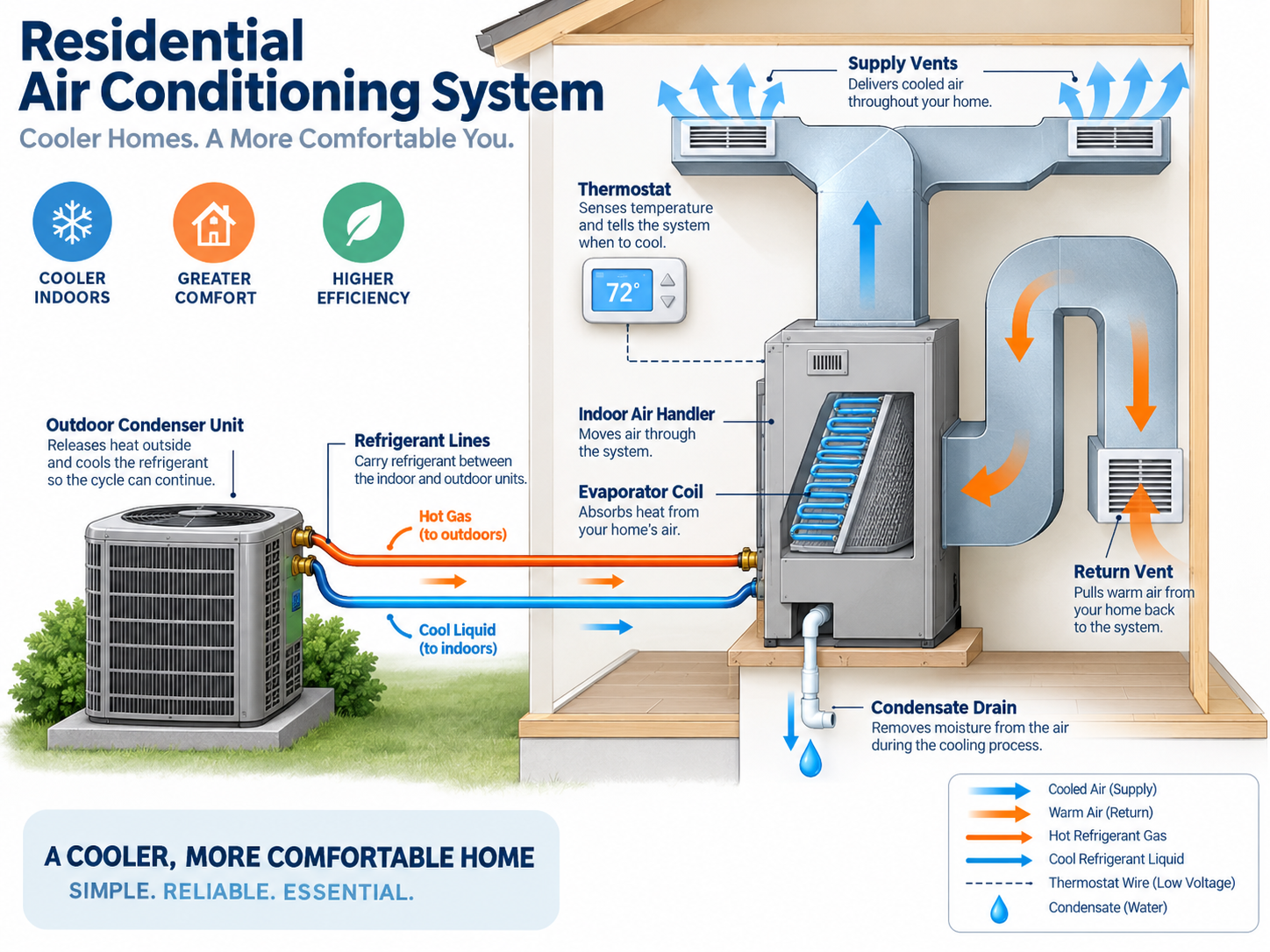
Cooling is heat movement, not cold production. Indoor air passes over a cold evaporator coil and gives up heat and moisture; refrigerant carries that heat outdoors, where the condenser releases it to the outside air. Both halves have to work, and enough air has to move across both coils.
That framing explains why so many different problems produce the same complaint. If the blower is starved by a dirty filter, the coil cannot absorb heat. If the outdoor fan is not running, the heat has nowhere to go. If refrigerant is low, less heat gets carried per cycle. In all three cases you feel the same thing: the system runs and the house stays warm.
Airflow problems
Airflow is the most common and most homeowner-addressable cause. A loaded filter, closed or blocked returns, furniture over registers, a dirty evaporator coil, or a weakening blower motor all reduce the volume of air passing over the coil.
The tell is often weak air at the vents even though the air that does come out feels cool. Left long enough, restricted airflow drops coil temperature below freezing and ice forms, which cuts airflow further until nothing moves at all.
- Replace the return filter and note how dirty it was
- Open all supply registers and clear returns
- Check for ice on the coil or the larger copper line
- Listen for a blower that sounds slower or louder than usual
Refrigerant problems
Refrigerant is not consumed during normal operation, so a low charge should be investigated rather than routinely topped off. A leak is the most common cause, though an incorrect charge left by previous service is also possible, and adding refrigerant without understanding why it is low may not solve the problem. Symptoms include gradual capacity loss across a summer, longer runtimes, ice at the coil or on the suction line, and higher-than-usual electric bills.
Charge has to be measured against manufacturer specifications using pressures, temperatures and superheat or subcooling calculations. It cannot be judged by feel, and topping off is not a repair.
Electrical and mechanical failures
If the indoor blower runs but the outdoor unit is silent or humming, the problem is usually in the condenser circuit: a failed run capacitor, a pitted contactor, a bad fan motor, or a compressor that will not start. The blower keeps circulating air, so the vents blow neutral air rather than nothing.
These components are behind panels carrying line voltage, and capacitors store a charge even after power is removed. Testing and replacement belong to a qualified technician.
Controls and thermostat
Before assuming equipment failure, confirm the thermostat is in Cool with a setpoint several degrees below room temperature and the fan on Auto rather than On. Fan set to On circulates air continuously, which feels like warm air whenever the compressor is off.
Dead batteries, a loose wire at the thermostat, a blown low-voltage fuse in the air handler, or a heat pump configured incorrectly all produce cooling complaints with nothing wrong in the equipment itself.
What a technician measures
A proper no-cool diagnosis is measurement-based rather than guesswork. Expect airflow and temperature split checks, static pressure, electrical readings on capacitors and motors, refrigerant pressures with superheat or subcooling, coil condition, and condensate system inspection.
Those readings distinguish between the causes above, which matters because the fixes range from a filter to a compressor.
- Return and supply temperature split
- Static pressure and blower performance
- Capacitor microfarads and motor amp draw
- Refrigerant pressures, superheat or subcooling
- Evaporator and condenser coil condition
- Condensate drain and float switch function
Warning signs to take seriously
- Burning or hot-plastic odor from any part of the system
- Breaker that trips again after a single reset
- Ice on the coil or refrigerant lines
- Water pooling near the indoor unit or staining a ceiling
- Loud grinding, screeching or repeated hard-start clunks
Related questions
Why does my AC run constantly but never cool the house?
Continuous runtime with poor cooling means the system cannot move enough heat to satisfy the thermostat. The usual causes are restricted airflow, a dirty condenser coil, a low refrigerant charge, or a compressor that is running but not pumping effectively. Start by replacing the filter and clearing debris from the outdoor unit; if that does not change anything, the system needs measurement.
Could a dirty filter really stop my AC from cooling?
Yes. A heavily loaded filter can reduce airflow enough to drop the evaporator coil below freezing. Once ice forms, airflow collapses and cooling stops almost entirely. It is the single most common cause that homeowners can fix themselves, and it is worth checking first every time.
Is it safe to add refrigerant myself?
No. Refrigerant is pressurized, handling is regulated, and overcharging causes as much damage as undercharging. More importantly, refrigerant is not consumed, so a low charge should be investigated — commonly a leak, sometimes an incorrect charge from previous service — rather than simply topped off. Charge work belongs to a qualified technician with proper gauges and recovery equipment.
How long should it take my AC to cool the house down?
A properly working residential system typically lowers indoor temperature a few degrees per hour on a hot day, and it will struggle to hold more than about a 20-degree difference from outdoor temperature. If the house has gotten very warm, recovery is slow by nature. Consistently losing ground in the afternoon is the sign that something needs attention.
Should I turn the system off while I wait for service?
If there is ice, water, or any burning smell, yes — shut it off, and leave the breaker off if you smelled something burning. If the only symptom is weak cooling, running the fan can help circulate air, but running a system that is icing or leaking risks compressor damage and water damage.
Service Request
Request Residential AC Service
Tell us what your air conditioner is doing and your request can be shared with local residential service providers serving the Montgomery area.
Urgent AC problem?
Calling is usually the fastest way to check current residential availability, including nights and weekends.
334-835-344524/7 and same-day availability depends on participating providers, location and current technician capacity.
Don't Sit in a Hot House
If your home AC isn't cooling properly, call to check current residential service availability in Montgomery and nearby communities.
24/7 and same-day availability depends on participating providers, location and current technician capacity.