
Why Is My Upstairs Hot While Downstairs Is Cool?
Heat rises, upstairs rooms sit under a hot attic, and the ducts serving them are usually the longest in the house. A temperature difference between floors is partly physics and partly system performance — insufficient supply airflow, limited return air, leaking or disconnected ducts, a dirty filter or coil, closed vents, poor balancing, thermostat placement, zoning faults, insulation gaps and equipment sizing all contribute.
24/7 and same-day availability depends on participating providers, location and current technician capacity.
Quick answer
Heat rises, upstairs rooms sit under a hot attic, and the ducts serving them are usually the longest in the house. A temperature difference between floors is partly physics and partly system performance — insufficient supply airflow, limited return air, leaking or disconnected ducts, a dirty filter or coil, closed vents, poor balancing, thermostat placement, zoning faults, insulation gaps and equipment sizing all contribute.
Some difference between floors is expected
Warm air rises, and a second floor is bounded by an attic that gets far hotter than any other space in the house. Even a well-performing system leaves the upper floor a few degrees warmer on a hot afternoon.
What is not normal is a large gap, a gap that appeared recently, or an upstairs that never becomes comfortable no matter how long the system runs. Those point to something specific rather than to physics.
Insufficient supply airflow
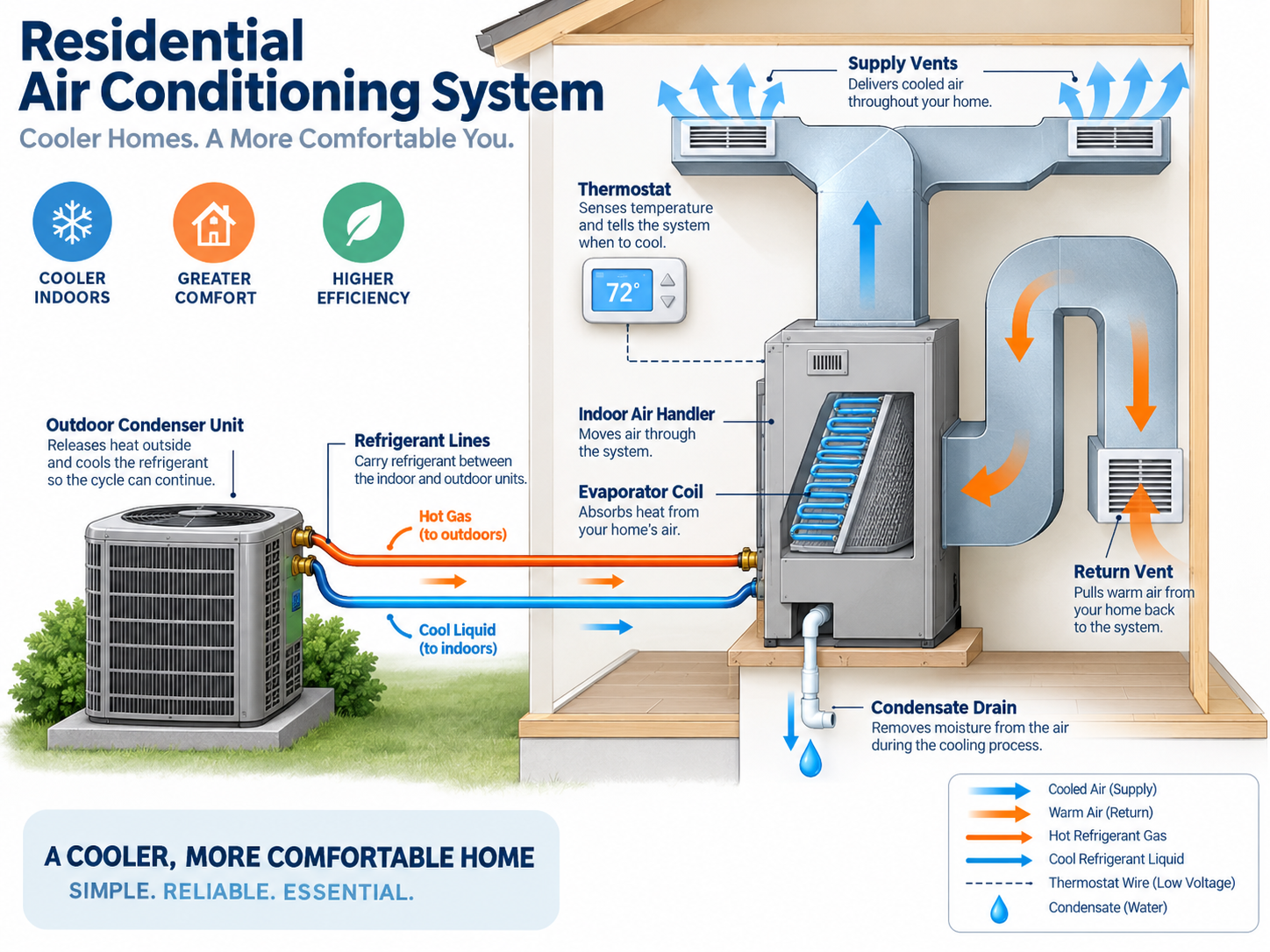
Upstairs rooms are usually at the end of the longest duct runs. Every foot of duct, every bend and every restriction costs airflow, and the last room on a branch feels it first.
Hold your hand at an upstairs register and compare it to one downstairs. Weak air upstairs while downstairs registers push strongly is a distribution problem, not a cooling-capacity problem, and it is diagnosed with airflow measurement rather than by adding refrigerant.
Return-air limitations
Supply air can only enter a room if the same volume of air can leave it. Many homes have generous supply registers upstairs and a single undersized return, or no upstairs return at all, which throttles the whole upper floor.
Closed doors compound this. A bedroom with a supply register, a closed door and no return path or door undercut becomes pressurized and stops accepting cool air. If upstairs rooms cool better with doors open, return air is a strong suspect.
Attic heat gain
An attic in a central Alabama summer becomes extremely hot, and that heat pushes down through the ceiling into the rooms below. Insufficient or displaced attic insulation, gaps around can lights and access hatches, and inadequate attic ventilation all increase what the system has to overcome upstairs.
Ducts running through that attic are also fighting it. Cooled air traveling through a hot space in poorly insulated duct arrives warmer than it left, which is why upstairs supply air sometimes feels only mildly cool.
Duct leakage and disconnected ducts
Leaking supply duct dumps conditioned air into the attic. A duct that has come loose at a boot or plenum connection can starve an entire room or hallway while the system runs normally in every other respect.
A sudden change — an upstairs room that used to be fine and now never cools — is a classic disconnected-duct pattern. Return-side leakage is the mirror problem: the system pulls hot, humid attic air into the return and delivers it back to the house.
Dirty filter, dirty coil and blower condition
Anything that reduces total airflow reduces it most at the weakest end of the duct system, which is usually upstairs. A loaded filter, a fouled evaporator coil or a dirty blower wheel can turn an acceptable imbalance into an uncomfortable one.
This is the reason the filter is the first check even for a problem that feels like a layout issue. It is cheap, quick, and it genuinely changes the symptom in some homes.
Closed vents and poor balancing
Closing downstairs registers to push more air upstairs sounds logical and usually backfires: it raises system static pressure, reduces total airflow and can contribute to coil freezing. Balancing is done at dampers in the duct system, not by shutting off rooms.
Many homes have adjustable dampers on branch ducts that have never been set correctly, or were set for heating season and never revisited. Proper balancing is measured rather than guessed, and it is a legitimate service request on its own.
Thermostat location and zoning issues
A single thermostat downstairs controls the whole system based on the air in one location. Once that spot is satisfied, cooling stops regardless of how the upstairs feels. A thermostat in a cool hallway, or one exposed to a draft, exaggerates the problem.
Homes with zoning have dampers, a control panel and sometimes multiple thermostats. A failed zone damper, a dead zone thermostat or a control fault can produce exactly this complaint, and the diagnosis is different from a single-zone system.
Insulation and system sizing limitations
Insulation and air sealing determine how much heat gets in before the system ever has to deal with it. Recessed lights, attic hatches, knee walls and bonus rooms over garages are common weak points and often explain a single problem room.
Sizing and duct design matter too. A system and duct layout adequate for the main floor may simply not have the capacity or distribution to serve a second floor well. That is a design conversation with a provider, not a repair, and it should be based on measurements rather than assumptions.
What Homeowners Can Check Safely
None of these require tools, panels or training. They also give a technician a much better starting point if service turns out to be needed.
- Replace the filter at every return location and note how dirty it was
- Open all supply registers upstairs and downstairs rather than closing any
- Clear furniture, rugs and curtains away from registers and return grilles
- Compare airflow by hand at upstairs and downstairs registers
- Note whether upstairs rooms do better with doors open
- Check that the thermostat is in COOL with the fan on AUTO
- Look in the attic from the hatch, without walking on insulation, for obviously disconnected or crushed duct
- Note the temperature difference between floors at the hottest part of the day
When It May Be an HVAC Problem
Physics explains a few degrees. The following patterns suggest something is wrong with the equipment, the ducts or the controls, and are worth having measured.
- Airflow at upstairs registers is very weak or nearly absent
- Supply air upstairs is not appreciably cool even at the register
- The problem appeared suddenly rather than gradually
- The gap between floors is large and does not close after long runtimes
- One specific room is far worse than the rest of the same floor
- Upstairs humidity feels high in addition to the temperature
- The system runs continuously without satisfying either floor
- A zoned system shows no change when zone settings are adjusted
Temperature imbalance, and what it may point toward
| What you notice | Possible areas to investigate | What to do next |
|---|---|---|
| Weak air at upstairs registers | Duct restriction, leakage, filter, blower | Change the filter, then arrange airflow measurement |
| One room much worse than the rest | Disconnected duct, damper position, insulation | Note the room and arrange inspection |
| Problem appeared suddenly | Duct disconnection, damper failure, blower issue | Arrange diagnosis rather than adjusting vents |
| Cool downstairs, humid upstairs | Return-air limitation, duct leakage, runtime | Confirm settings and filter, then arrange diagnosis |
| No change from zone adjustments | Zone dampers, zone control, zone thermostats | Mention the zoning system when requesting service |
Warning signs to take seriously
- An upstairs room that stays hot enough to be a health concern in extreme heat
- Airflow at a register that has stopped almost completely
- Visible duct damage or disconnection where it can be seen safely
- Ice on the coil or refrigerant line after vents were closed to redirect air
- The system running continuously without satisfying either floor
Related questions
Should I close downstairs vents to force more air upstairs?
It rarely works and can cause harm. Closing registers raises static pressure across the whole duct system, reduces total airflow, strains the blower and can drop the coil low enough to freeze. Balance is achieved with dampers in the duct system, adjusted based on measurement. If upstairs needs more air, that is the correct path, along with checking for leakage and return limitations.
Would adding refrigerant help my hot upstairs?
Not unless measurement shows the charge is actually low, and a low charge is worth investigating, most often for a leak. A distribution problem — weak airflow upstairs while downstairs cools normally — is not solved by refrigerant. Ask any provider to show you what they measured before agreeing to add anything to a sealed system.
Is a second system or zoning the only real fix?
Sometimes it is the right answer for a two-story home, but it should be the conclusion of a diagnosis, not the opening suggestion. Duct sealing, correcting a disconnected duct, adding or enlarging return air, balancing with dampers, and improving attic insulation resolve many cases at far lower cost. Ask what was measured and what specifically each option would change.
Why is the bonus room over the garage always the worst?
Rooms over garages and behind knee walls are surrounded by unconditioned space on several sides, often have long duct runs, and frequently have limited return air. They are the hardest spaces in a house to condition. Insulation, air sealing, duct condition and return air all matter more there than anywhere else in the home.
Does a smart thermostat fix an upstairs temperature problem?
A thermostat can only start and stop the equipment. If the upstairs is short on airflow, sitting under a hot attic or served by leaking duct, a different thermostat changes nothing about those conditions. Remote sensors can help a control respond to a different location, but they are a scheduling improvement rather than a repair.
Should the fan run continuously to even out the floors?
Continuous fan operation moves air between floors and can reduce the temperature spread slightly, but during cooling season it also tends to raise indoor humidity because moisture on the coil re-evaporates. If you are relying on it, the underlying airflow or duct problem is worth diagnosing instead.
Related AC Problems
Service Request
Request Residential AC Service
Tell us what your air conditioner is doing and your request can be shared with local residential service providers serving the Montgomery area.
Urgent AC problem?
Calling is usually the fastest way to check current residential availability, including nights and weekends.
334-835-344524/7 and same-day availability depends on participating providers, location and current technician capacity.
Don't Sit in a Hot House
If your home AC isn't cooling properly, call to check current residential service availability in Montgomery and nearby communities.
24/7 and same-day availability depends on participating providers, location and current technician capacity.