Why Does My AC Keep Running?
Continuous operation means the system cannot reach the thermostat setpoint, usually because of lost capacity or an unrealistic setting for the outdoor conditions. Short cycling — starting and stopping repeatedly — is a different problem, often a safety control tripping, and it is harder on equipment than long runtimes.
24/7 and same-day availability depends on participating providers, location and current technician capacity.
Quick answer
Continuous operation means the system cannot reach the thermostat setpoint, usually because of lost capacity or an unrealistic setting for the outdoor conditions. Short cycling — starting and stopping repeatedly — is a different problem, often a safety control tripping, and it is harder on equipment than long runtimes.
Long runtimes are not always a fault
On the hottest afternoons of a central Alabama summer, a correctly sized residential system may run nearly continuously. That is expected behavior: equipment is sized for typical design conditions, not for the extremes, and holding a large indoor-outdoor temperature difference takes sustained runtime.
What matters is whether the system holds the setpoint while it runs. Running constantly and maintaining 74 is normal on a 98-degree day. Running constantly while the house drifts up to 80 is not.
Causes of lost capacity
When a system that used to keep up no longer does, the usual causes are restricted airflow, a fouled condenser coil, a low refrigerant charge, a compressor no longer pumping at full capacity, or significant duct leakage into an attic.
Envelope factors matter too. Added insulation gaps, failing window seals, attic ducts leaking conditioned air and increased solar gain all raise the load the equipment has to overcome.
- Filter and returns clear
- Outdoor coil clean and unobstructed
- Supply air noticeably cooler than return air
- No ice on coil or lines
- Thermostat setpoint realistic for outdoor conditions
Short cycling is a different problem
A system that starts, runs briefly and shuts off repeatedly is usually being stopped by something rather than satisfying the thermostat. Common causes include a high-pressure trip from a dirty condenser, a low-pressure or freeze protection trip, a condensate float switch, a failing capacitor causing hard starts, an oversized system, or a thermostat placed in a poor location.
Short cycling is mechanically punishing. Compressor starts draw the highest current of any part of the cycle, and frequent starts shorten equipment life meaningfully.
Thermostat and control factors
A thermostat mounted in direct sun, near a supply register, on an exterior wall or above a heat-producing appliance reads a temperature the rest of the house does not share. That produces both continuous running and short cycling depending on the direction of the error.
Fan set to On also confuses the picture: the blower runs constantly and it sounds as if the system never stops even when the compressor is cycling normally.
What a technician checks
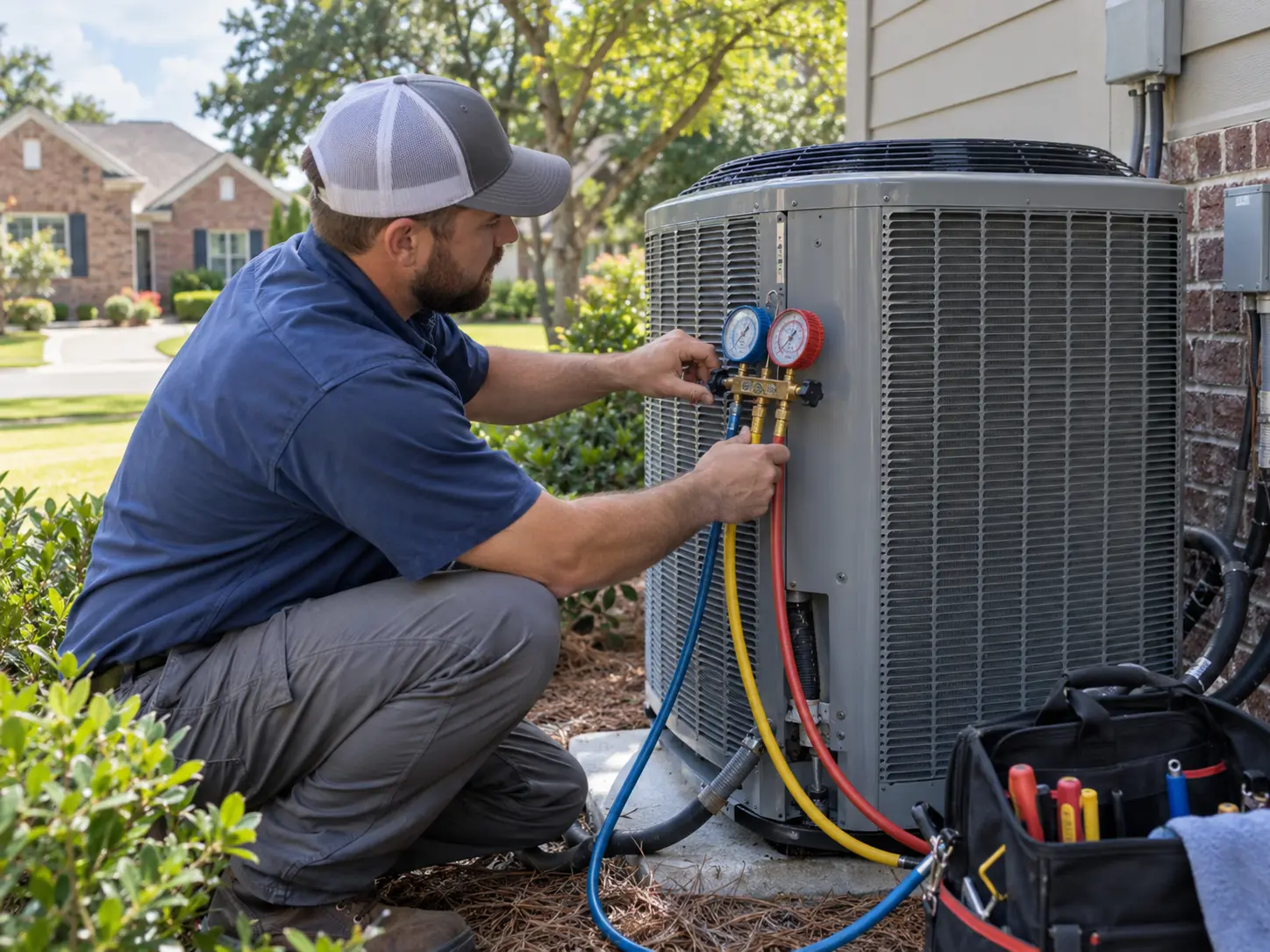
Diagnosis here is about measurement over time rather than a single reading. Expect temperature split, static pressure, refrigerant pressures with superheat or subcooling, electrical values, safety control status, and a look at duct condition and thermostat placement.
Those readings separate a system that is genuinely undersized or worn out from one that has a correctable restriction or a tripping safety.
Warning signs to take seriously
- Compressor starting more than a few times per hour in steady heat
- Electric bills rising sharply with no change in habits
- Indoor temperature climbing through the afternoon despite constant runtime
- Breaker tripping on compressor start
- Repeated shutdowns with water in the drain pan
Related questions
Is it bad for my AC to run all day?
Long runtimes in extreme heat are normal and generally easier on equipment than frequent starts. The concern is when constant running no longer holds the setpoint, because that indicates lost capacity from airflow, coil, charge or compressor issues — and it drives up energy use while comfort declines.
How often should my AC cycle on and off?
In moderate weather, roughly two to four cycles per hour with runtimes of ten minutes or more is typical. In extreme heat, cycles get longer and may become continuous. Very short runtimes repeated many times per hour indicate short cycling and should be investigated.
Will a lower thermostat setting cool the house faster?
No. A single-stage system removes heat at one rate regardless of setpoint, so setting 65 instead of 74 does not speed anything up. It only guarantees the system runs continuously without ever satisfying, which increases runtime, energy use and the chance of freezing the coil.
Could my system just be too small?
It is possible, particularly if the house has been modified or the equipment was never properly sized. But undersizing is diagnosed after ruling out airflow restriction, coil fouling, charge problems and duct leakage — all of which mimic undersizing and are far cheaper to correct.
Does short cycling damage the compressor?
Yes, over time. Each start places high electrical and mechanical stress on the compressor, and frequent starts also prevent proper oil return and dehumidification. Persistent short cycling is worth diagnosing promptly rather than tolerating.
Service Request
Request Residential AC Service
Tell us what your air conditioner is doing and your request can be shared with local residential service providers serving the Montgomery area.
Urgent AC problem?
Calling is usually the fastest way to check current residential availability, including nights and weekends.
334-835-344524/7 and same-day availability depends on participating providers, location and current technician capacity.
Don't Sit in a Hot House
If your home AC isn't cooling properly, call to check current residential service availability in Montgomery and nearby communities.
24/7 and same-day availability depends on participating providers, location and current technician capacity.