
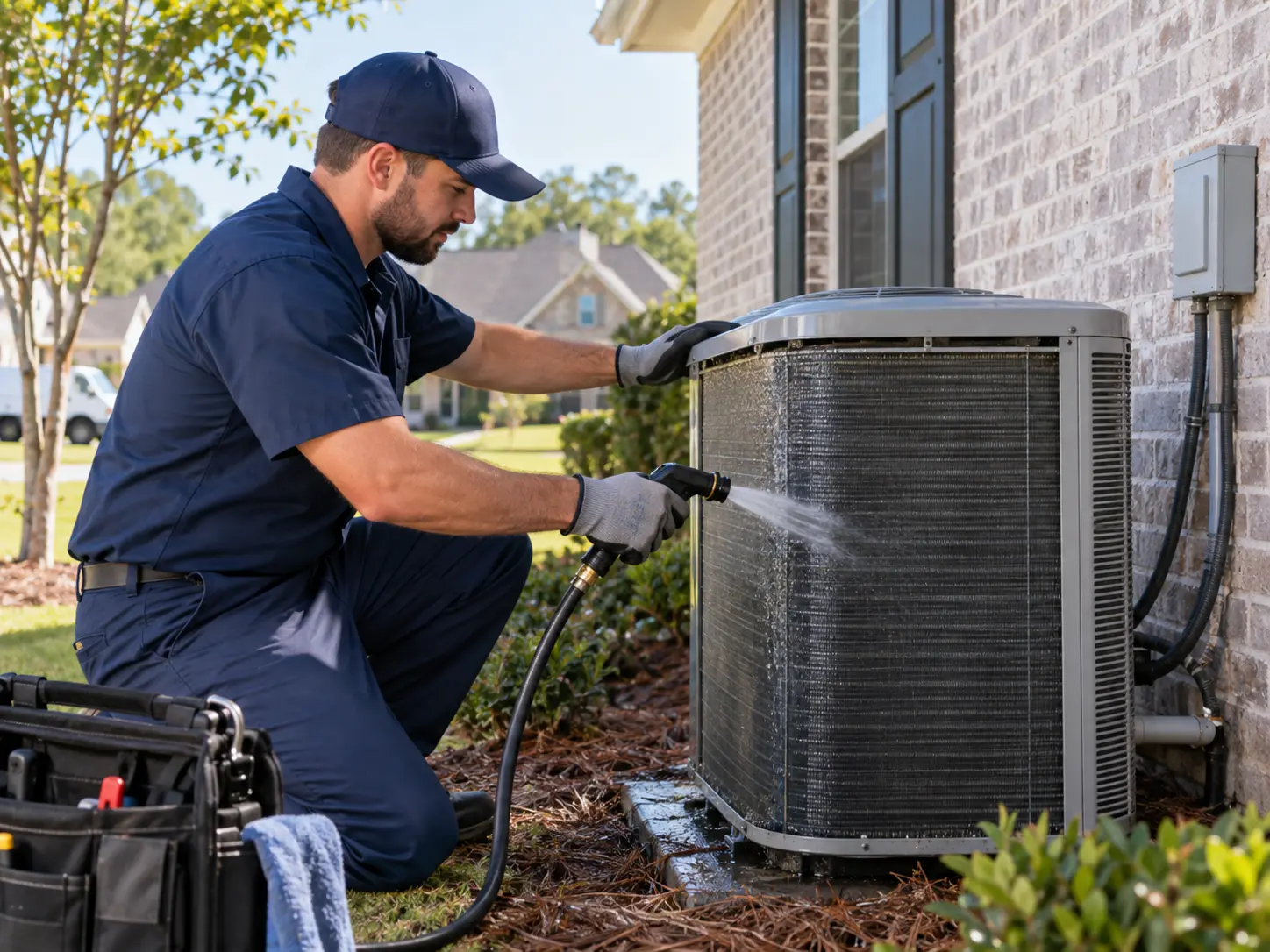
Frozen AC Unit in Montgomery, AL
Ice on an air conditioner is a symptom, not a cause. The coil freezes when it gets too cold for the amount of air passing over it, and there are only a few reasons that happens.
24/7 and same-day availability depends on participating providers, location and current technician capacity.
An evaporator coil normally runs cold but above freezing. Two conditions push it below 32°F: not enough warm air moving across it, or not enough refrigerant absorbing heat inside it. Once frost starts, it compounds — ice blocks airflow, the coil gets colder, and the freeze accelerates until almost no air moves.
That is why forcing a frozen system to keep running is counterproductive. With the coil iced, refrigerant can return to the compressor as liquid, which is one of the ways compressors are damaged.
The correct sequence is to turn cooling off, run the fan only so household air melts the ice, then look for the underlying cause. If the system freezes again after thawing, the cause is still present and needs measurement.
Symptoms homeowners notice
- Visible ice or frost on the indoor coil or the copper lines
- Very weak airflow from the supply vents
- Water on the floor after the system is turned off and ice melts
- A hissing or gurgling sound near the indoor unit
- Cooling that works for a while, then quits each afternoon
What you can safely check
- Turn the thermostat from Cool to Off, then set the fan to On to thaw the coil
- Allow several hours for a fully iced coil to melt completely
- Replace the air filter while the system thaws
- Open all supply registers and clear obstructions from return grilles
- Place towels near the indoor unit to catch melt water
Never open electrical compartments, handle refrigerant or bypass a safety control. Those steps belong to a qualified HVAC professional.
Likely causes
Airflow starvation
A clogged filter, undersized or closed returns, a failing blower motor or crushed flex duct all reduce airflow enough to freeze a coil.
Dirty evaporator coil
A coil coated with dust and biofilm both insulates the fins and blocks air passages, producing the same effect as a dirty filter even with a new filter installed.
Low refrigerant charge
With less refrigerant in the coil, pressure drops and the remaining refrigerant boils at a lower temperature — often below freezing. Ice frequently forms at the coil inlet or along the suction line.
Blower speed or motor problems
A blower running at the wrong tap or a motor slowing down under load moves less air than the coil requires.
Running in cool outdoor temperatures
Operating cooling on an unusually cool evening can drop coil temperature low enough to freeze on systems without low-ambient controls.
Why Does My AC Freeze During Hot, Humid Weather?
Freezing in the hottest, most humid part of the season sounds backwards, but it is the most common time for it to happen. The evaporator coil is cold by design; it only stays above freezing because a steady volume of warm, moist indoor air keeps moving across it. When anything reduces that airflow — or when refrigerant conditions are wrong — coil temperature drops below freezing, moisture in the air turns to ice instead of condensate, and the ice then blocks even more airflow. The problem accelerates on itself.
Humid weather feeds the process because there is simply more moisture available to freeze onto the coil, and long runtimes give it hours to accumulate rather than minutes.
If substantial ice is visible, continuing to force the system to cool can make the problem worse. Ice restricts airflow further, liquid refrigerant can return to the compressor, and melt water can overwhelm the drain pan and reach flooring or ceilings.
- Restricted airflow — the most frequent contributor of all
- A dirty or overly restrictive filter
- A dirty evaporator coil that air cannot pass through properly
- Blower problems: wrong speed, a fouled blower wheel, a failing motor
- Refrigerant issues, including low charge from a leak or an incorrect charge
- Thermostat or control problems causing the system to run when it should not
- Closed registers, blocked returns or crushed duct reducing total airflow
When professional service is needed
- The system freezes again shortly after thawing
- Ice returns even with a brand-new filter
- You hear hissing, which can indicate a refrigerant leak
- The blower sounds weak, noisy or slower than usual
- Ice appears on the outdoor unit during cooling season
What a provider may inspect
- Airflow measurement and total external static pressure
- Evaporator coil condition behind the access panel
- Blower wheel cleanliness, speed tap and motor amp draw
- Refrigerant charge with superheat or subcooling calculation
- Leak search on coils, fittings and the line set
- Metering device performance at the coil
Montgomery-area context
High humidity through a central Alabama cooling season means the evaporator coil is constantly wet, which lets dust bond to the fins. Coils in this climate tend to load up faster than in dry regions, and coil cleanliness is a genuine performance issue rather than a cosmetic one.
Long runtimes also mean a freeze can develop and thaw repeatedly in a single day — running fine in the morning, iced by mid-afternoon. Homeowners often describe this as intermittent cooling.
If the drain line is also restricted, melt water from a thawing coil can overflow the pan, which is why a freeze sometimes shows up first as water on a closet or hallway floor.
What About Repair Cost?
Pricing is set by each independent provider and varies with the diagnosis, the system involved, the specific component, how accessible the equipment is, parts availability and labor. Ask the provider you speak with to explain their diagnostic process and how they quote work before it begins.
Common questions
Should I turn my AC off if it freezes?
Yes. Switch cooling to Off and set the fan to On so warm household air melts the ice. Running the compressor with an iced coil can allow liquid refrigerant to return to it, which risks expensive damage. Once everything has thawed, replace the filter and restart. If ice comes back, the underlying cause is still there.
How long does it take a frozen AC coil to thaw?
With the fan running, a light frost may clear in under an hour, while a fully iced coil can take four to eight hours. Do not chip at the ice or use a heat gun — you can puncture the coil or damage the fins. Expect melt water, and keep towels handy if the drain pan is close to capacity.
Why does my AC keep freezing up over and over?
Repeat freezing usually comes down to one of two things: airflow is still restricted, or the refrigerant charge is low. Filters, a dirty coil, a weak blower or duct restrictions cover the airflow side. A low charge should be investigated rather than simply topped off — commonly a leak, sometimes charge lost or set incorrectly during earlier service — or the freeze will return.
Can a frozen AC damage my system?
It can. Prolonged operation with an iced coil stresses the compressor, and melting ice can overwhelm the condensate drain and spill into the surrounding structure. Shutting cooling off and letting it thaw protects both the equipment and your home while you arrange service.
Service Request
Request Residential AC Service
Tell us what your air conditioner is doing and your request can be shared with local residential service providers serving the Montgomery area.
Urgent AC problem?
Calling is usually the fastest way to check current residential availability, including nights and weekends.
334-835-344524/7 and same-day availability depends on participating providers, location and current technician capacity.
Don't Sit in a Hot House
If your home AC isn't cooling properly, call to check current residential service availability in Montgomery and nearby communities.
24/7 and same-day availability depends on participating providers, location and current technician capacity.